Project III--GDP components over time and among countries
Challenge:GDP components over time and among countries
At the risk of oversimplifying things, the main components of gross domestic product, GDP are personal consumption (C), business investment (I), government spending (G) and net exports (exports - imports). You can read more about GDP and the different approaches in calculating at the Wikipedia GDP page.
The GDP data we will look at is from the United Nations’ National Accounts Main Aggregates Database, which contains estimates of total GDP and its components for all countries from 1970 to today. We will look at how GDP and its components have changed over time, and compare different countries and how much each component contributes to that country’s GDP. The file we will work with is GDP and its breakdown at constant 2010 prices in US Dollars and it has already been saved in the Data directory. Have a look at the Excel file to see how it is structured and organised
UN_GDP_data  <-  read_excel(here::here("data","Download-GDPconstant-USD-countries.xls"), # Excel filename
                sheet="Download-GDPconstant-USD-countr", # Sheet name
                skip=2) # Number of rows to skip
The first thing you need to do is to tidy the data, as it is in wide format and you must make it into long, tidy format. Please express all figures in billions (divide values by 1e9, or \(10^9\)), and you want to rename the indicators into something shorter.
make sure you remove
eval=FALSEfrom the next chunk of R code– I have it there so I could knit the document
tidy_GDP_data<-UN_GDP_data %>%
  pivot_longer(cols=c(4:51),names_to="year",values_to="figure") %>%
  mutate(figure=figure/1e9)
tidy_GDP_data<-tidy_GDP_data %>%
  clean_names() %>%
  mutate(Indicator_Name=case_when(
    tidy_GDP_data$IndicatorName=="Exports of goods and services"~"Exports",
    tidy_GDP_data$IndicatorName=="Household consumption expenditure (including Non-profit institutions serving households)"~"Household expeniture",
    tidy_GDP_data$IndicatorName=="Imports of goods and services"~"Imports",
    tidy_GDP_data$IndicatorName=="General government final consumption expenditure"~"Government expenditure",
    tidy_GDP_data$IndicatorName=="Gross capital formation"~"Gross capital formation",
    TRUE~ "Other Data"))

 # Let us compare GDP components for these 3 countries
country_list <- c("United States","India", "Germany")
First, can you produce this plot?
three_country<-tidy_GDP_data %>% filter(country %in% country_list)%>%
  filter(Indicator_Name %in% c("Gross capital formation", "Exports","Household expeniture","Imports","Government expenditure"))


ggplot(three_country,aes(x=year,y=figure,color=Indicator_Name))+
  geom_point(size=0.5)+
  geom_line(aes(group=Indicator_Name))+
  facet_wrap(~country)+
  theme(legend.position = "right")+
  guides(colour = guide_legend(nrow = 5))+
  theme(axis.text.x = element_text(angle = 90))+
  scale_x_discrete(breaks=c(1970,1980,1990,2000,2010))+
  labs(title="GDP components over time", subtitle="In constant 2010 USD", x="",
       y="Billion US$")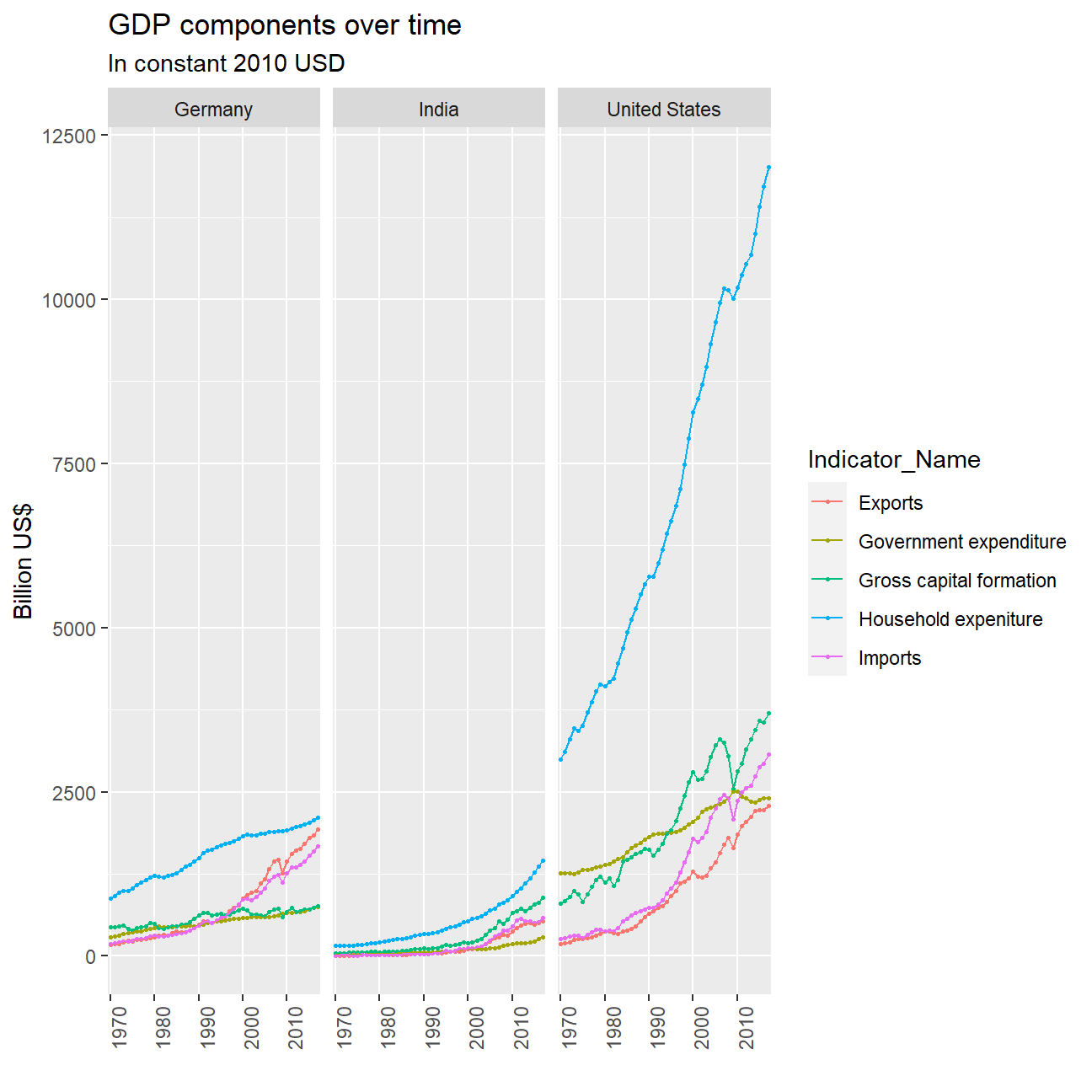
Secondly, recall that GDP is the sum of Household Expenditure (Consumption C), Gross Capital Formation (business investment I), Government Expenditure (G) and Net Exports (exports - imports). Even though there is an indicator Gross Domestic Product (GDP) in your dataframe, I would like you to calculate it given its components discussed above.
What is the % difference between what you calculated as GDP and the GDP figure included in the dataframe?
export<-three_country %>%
  filter(Indicator_Name=="Exports")

Import<-three_country %>%
  filter(Indicator_Name=="Imports")

net_export_join<-left_join(export,Import, by=c("country","year"))

net_export<-net_export_join%>%
  mutate(net_export=net_export_join$figure.x-net_export_join$figure.y)%>%
  select(year,country,net_export)

G<-three_country %>%
  filter(Indicator_Name=="Government expenditure") %>%
  select(year,country,figure) %>%
  rename(government=figure)

C<-three_country %>%
  filter(Indicator_Name=="Household expeniture") %>%
  select(year,country,figure) %>%
  rename(Consumption=figure)

I<-three_country %>%
  filter(Indicator_Name=="Gross capital formation") %>%
  select(year,country,figure) %>%
  rename(Investment=figure)

GDP<-left_join(G,net_export,by=c("year","country")) %>%
  left_join(C,by=c("year","country")) %>%
  left_join(I,net_export,by=c("year","country")) %>%
  mutate(gdp=government+Investment+Consumption+net_export)

GDP_given<- tidy_GDP_data %>%
  filter(country %in% country_list) %>%
  filter(indicator_name=="Gross Domestic Product (GDP)") %>%
  select(year,country,figure) %>%
  rename(GDP_given=figure)

gdp_compared<-left_join(GDP,GDP_given,by=c("country","year")) %>%
  mutate(difference=(gdp-GDP_given)/GDP_given*100)
gdp_proportion<-gdp_compared %>%
mutate(goverment_prop=government/gdp*100,
net_export_prop=net_export/gdp*100,
Consumption_prop=Consumption/gdp*100,
Investment_prop=Investment/gdp*100) %>%
select(year,country,goverment_prop,net_export_prop,Investment_prop,Consumption_prop) %>%
pivot_longer(cols=c(3:6),names_to = "GDP_component",values_to = "proportion")
ggplot(gdp_proportion,aes(x=year,y=proportion,color=GDP_component))+
geom_point(size=0.5)+
geom_line(aes(group=GDP_component))+
facet_wrap(~country)+
theme(legend.position = "right")+
guides(colour = guide_legend(nrow = 5))+
theme(axis.text.x = element_text(angle = 90))+
scale_x_discrete(breaks=c(1970,1980,1990,2000,2010))+
labs(title="GDP and its breakdown at constant 2010 prices in US Dollars", x="",y="proportion")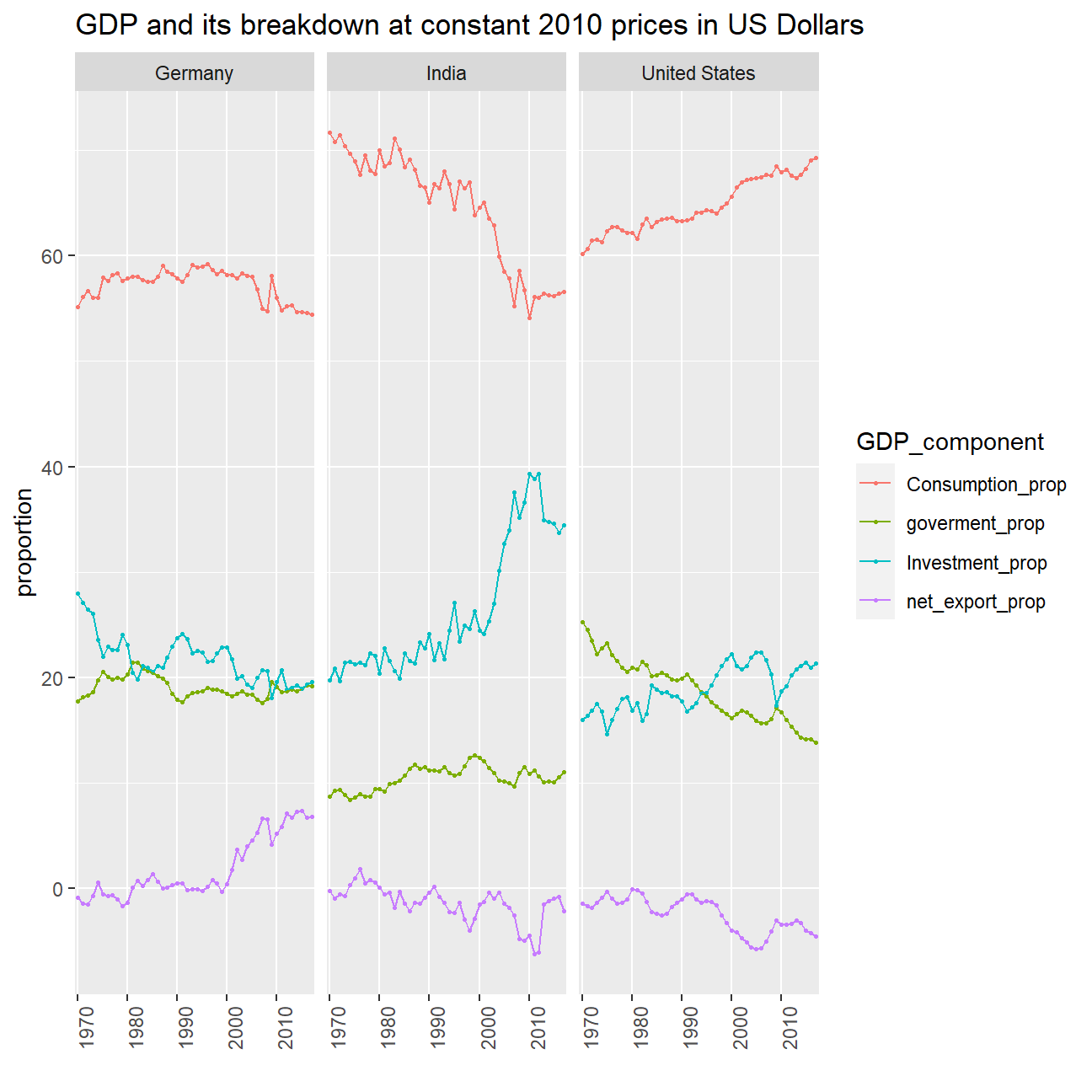
The last chart tells us the changes of 4 GDP components from 1970 to 2010 of Germany,India and the US. We could also tell the proportion of GDP components. For all three countries, the consumption ocupies the most proportion of the total GDP. Germany’s consumption proportion remained the same throughout 40 years, while the consumption proportion of the India decreased significantly, and the reason of that was that the investment proportion of the GDP went up during that period. The consumption proportion of the US went up smoothly. As for the net export, for all three countries, the net export all ocupied the least proportion of the total GDP. Specifically, the net export of Germany grew up since 2000, which meant that the exports of Germany began to be greater than the imports. On the contrary, the net export of the US gradually went down, meaning that its imports was still greater than the exports. For the government spending proportion, both India and Germany’s proportion remained the same during the 40 years, while the US decreased slightly, and it was just in the decreasing period of the government spending, the investment proportion of the US began to increase.