Pre-programme project

Task 1: gapminder country comparison
You have seen the gapminder dataset that has data on life expectancy, population, and GDP per capita for 142 countries from 1952 to 2007. To get a glimpse of the dataframe, namely to see the variable names, variable types, etc., we use the glimpse function. We also want to have a look at the first 20 rows of data.
glimpse(gapminder)## Rows: 1,704
## Columns: 6
## $ country <fct> "Afghanistan", "Afghanistan", "Afghanistan", "Afghanistan", ~
## $ continent <fct> Asia, Asia, Asia, Asia, Asia, Asia, Asia, Asia, Asia, Asia, ~
## $ year <int> 1952, 1957, 1962, 1967, 1972, 1977, 1982, 1987, 1992, 1997, ~
## $ lifeExp <dbl> 28.801, 30.332, 31.997, 34.020, 36.088, 38.438, 39.854, 40.8~
## $ pop <int> 8425333, 9240934, 10267083, 11537966, 13079460, 14880372, 12~
## $ gdpPercap <dbl> 779.4453, 820.8530, 853.1007, 836.1971, 739.9811, 786.1134, ~head(gapminder, 20) # look at the first 20 rows of the dataframe## # A tibble: 20 x 6
## country continent year lifeExp pop gdpPercap
## <fct> <fct> <int> <dbl> <int> <dbl>
## 1 Afghanistan Asia 1952 28.8 8425333 779.
## 2 Afghanistan Asia 1957 30.3 9240934 821.
## 3 Afghanistan Asia 1962 32.0 10267083 853.
## 4 Afghanistan Asia 1967 34.0 11537966 836.
## 5 Afghanistan Asia 1972 36.1 13079460 740.
## 6 Afghanistan Asia 1977 38.4 14880372 786.
## 7 Afghanistan Asia 1982 39.9 12881816 978.
## 8 Afghanistan Asia 1987 40.8 13867957 852.
## 9 Afghanistan Asia 1992 41.7 16317921 649.
## 10 Afghanistan Asia 1997 41.8 22227415 635.
## 11 Afghanistan Asia 2002 42.1 25268405 727.
## 12 Afghanistan Asia 2007 43.8 31889923 975.
## 13 Albania Europe 1952 55.2 1282697 1601.
## 14 Albania Europe 1957 59.3 1476505 1942.
## 15 Albania Europe 1962 64.8 1728137 2313.
## 16 Albania Europe 1967 66.2 1984060 2760.
## 17 Albania Europe 1972 67.7 2263554 3313.
## 18 Albania Europe 1977 68.9 2509048 3533.
## 19 Albania Europe 1982 70.4 2780097 3631.
## 20 Albania Europe 1987 72 3075321 3739.Your task is to produce two graphs of how life expectancy has changed over the years for the country and the continent you come from.
I have created the country_data and continent_data with the code below.
country_data <- gapminder %>%
            filter(country == "China")

continent_data <- gapminder %>%
            filter(continent == "Asia")
First, create a plot of life expectancy over time for the single country you chose. Map year on the x-axis, and lifeExp on the y-axis. You should also use geom_point() to see the actual data points and geom_smooth(se = FALSE) to plot the underlying trendlines. You need to remove the comments # from the lines below for your code to run.
plot1 <- ggplot(data = country_data, mapping = aes(x =year , y = lifeExp))+
   geom_point() +
   geom_smooth(se = FALSE)
# plot1
plot1
## `geom_smooth()` using method = 'loess' and formula 'y ~ x'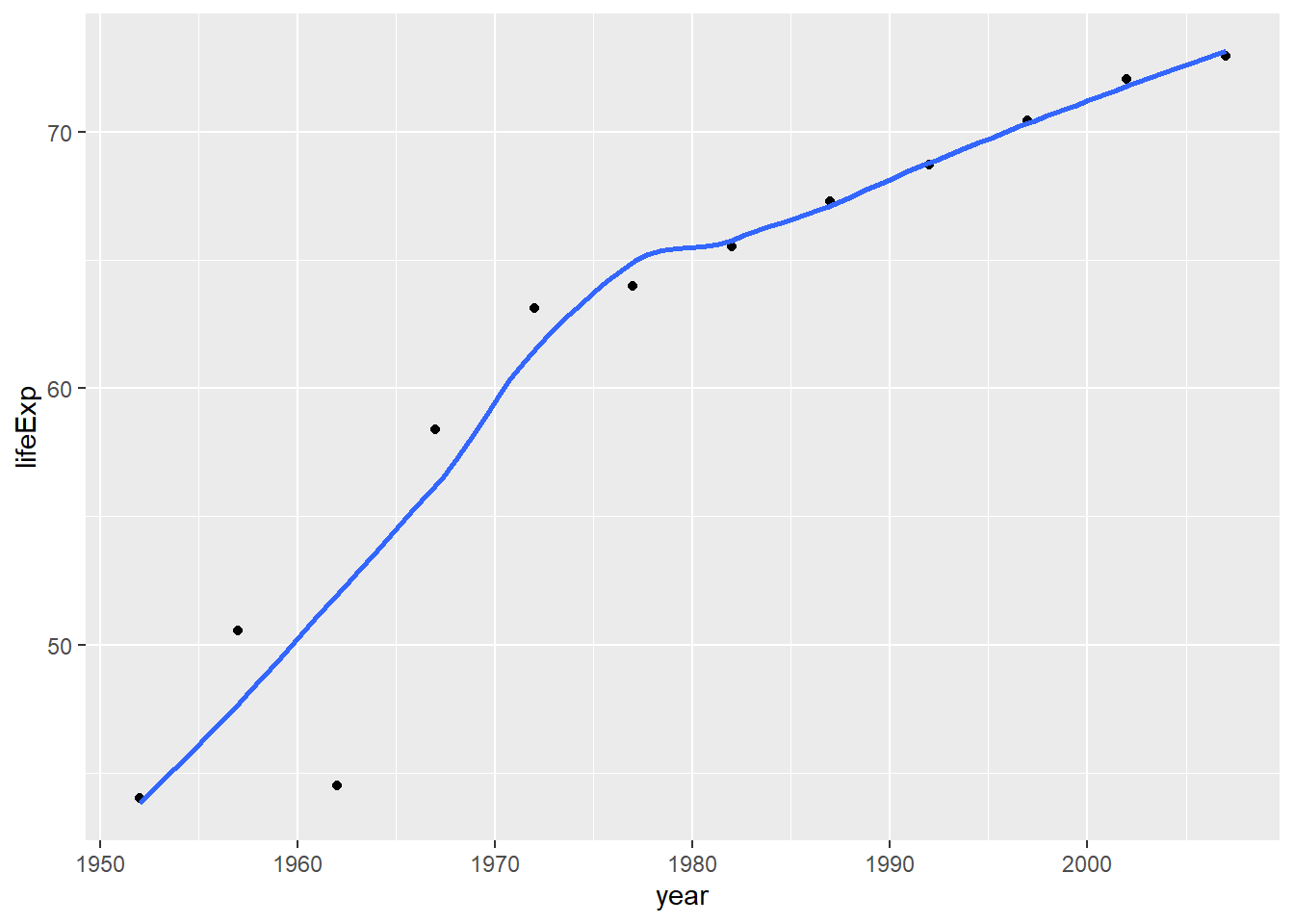
Next we need to add a title. Create a new plot, or extend plot1, using the labs() function to add an informative title to the plot.
plot1<- plot1 +
   labs(title = "China's Life Expectation ",
       x = "Year ",
       y = "Life Expectation ")
plot1
## `geom_smooth()` using method = 'loess' and formula 'y ~ x'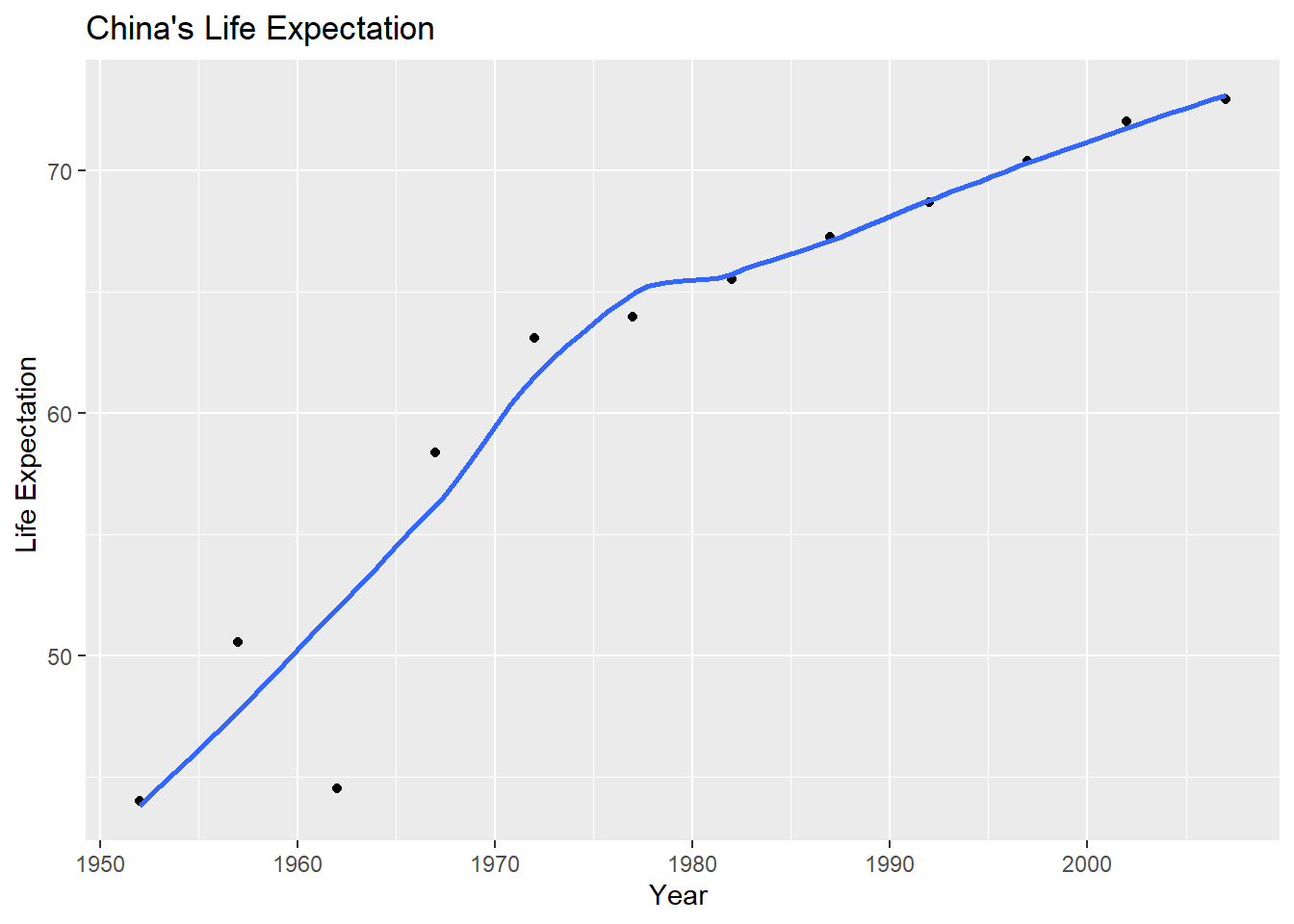
# plot1Secondly, produce a plot for all countries in the continent you come from. (Hint: map the country variable to the colour aesthetic. You also want to map country to the group aesthetic, so all points for each country are grouped together).
 ggplot(continent_data, mapping = aes(x = year , y = lifeExp , colour=country , group =country))+
   geom_point() +
   geom_smooth(se = FALSE)
## `geom_smooth()` using method = 'loess' and formula 'y ~ x'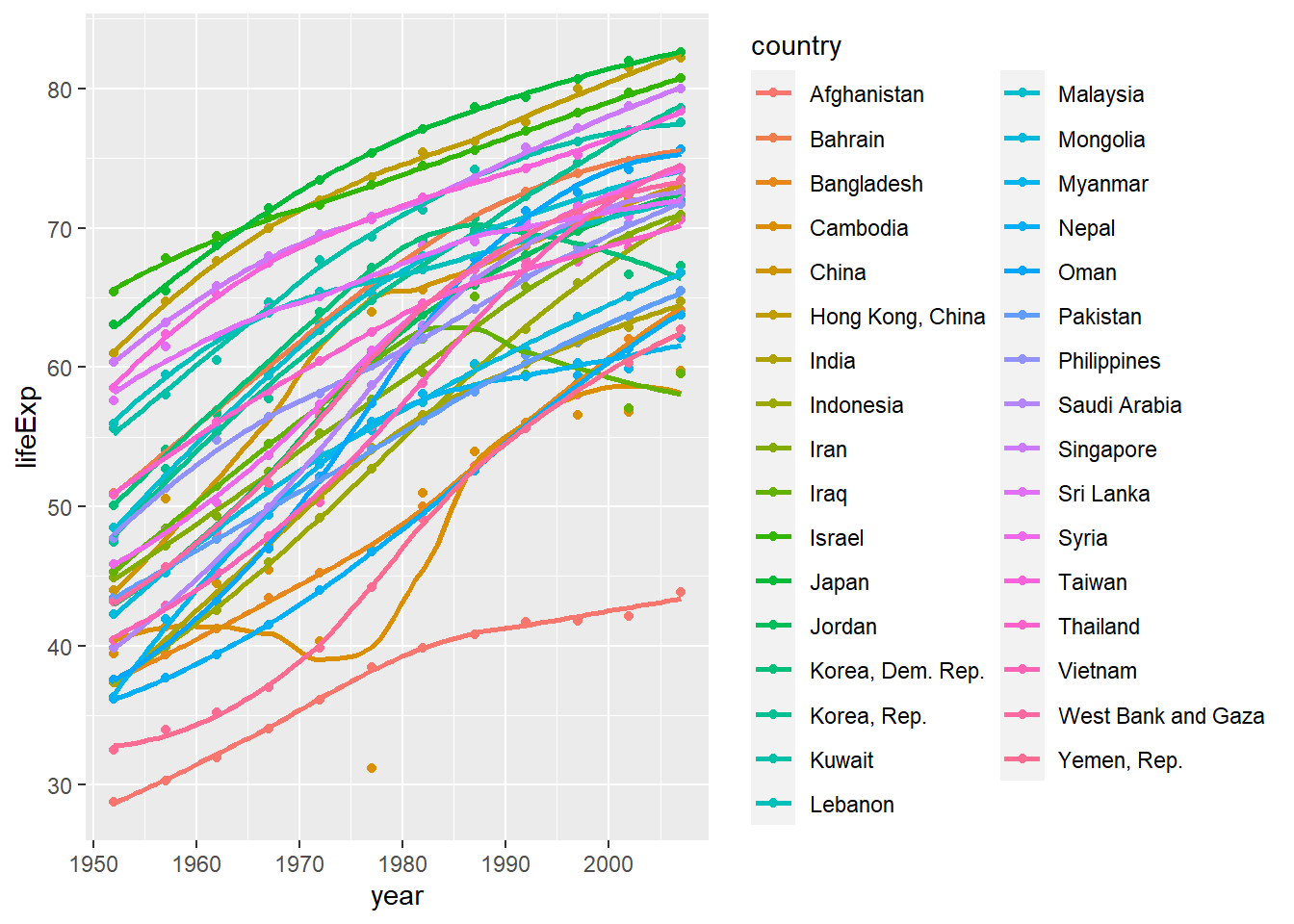
Finally, using the original gapminder data, produce a life expectancy over time graph, grouped (or faceted) by continent. We will remove all legends, adding the theme(legend.position="none") in the end of our ggplot.
 ggplot(data = gapminder, mapping = aes(x = year , y = lifeExp , colour=continent))+
   geom_point() +
   geom_smooth(se = FALSE) +
   facet_wrap(~continent) +
   theme(legend.position="none")
## `geom_smooth()` using method = 'loess' and formula 'y ~ x'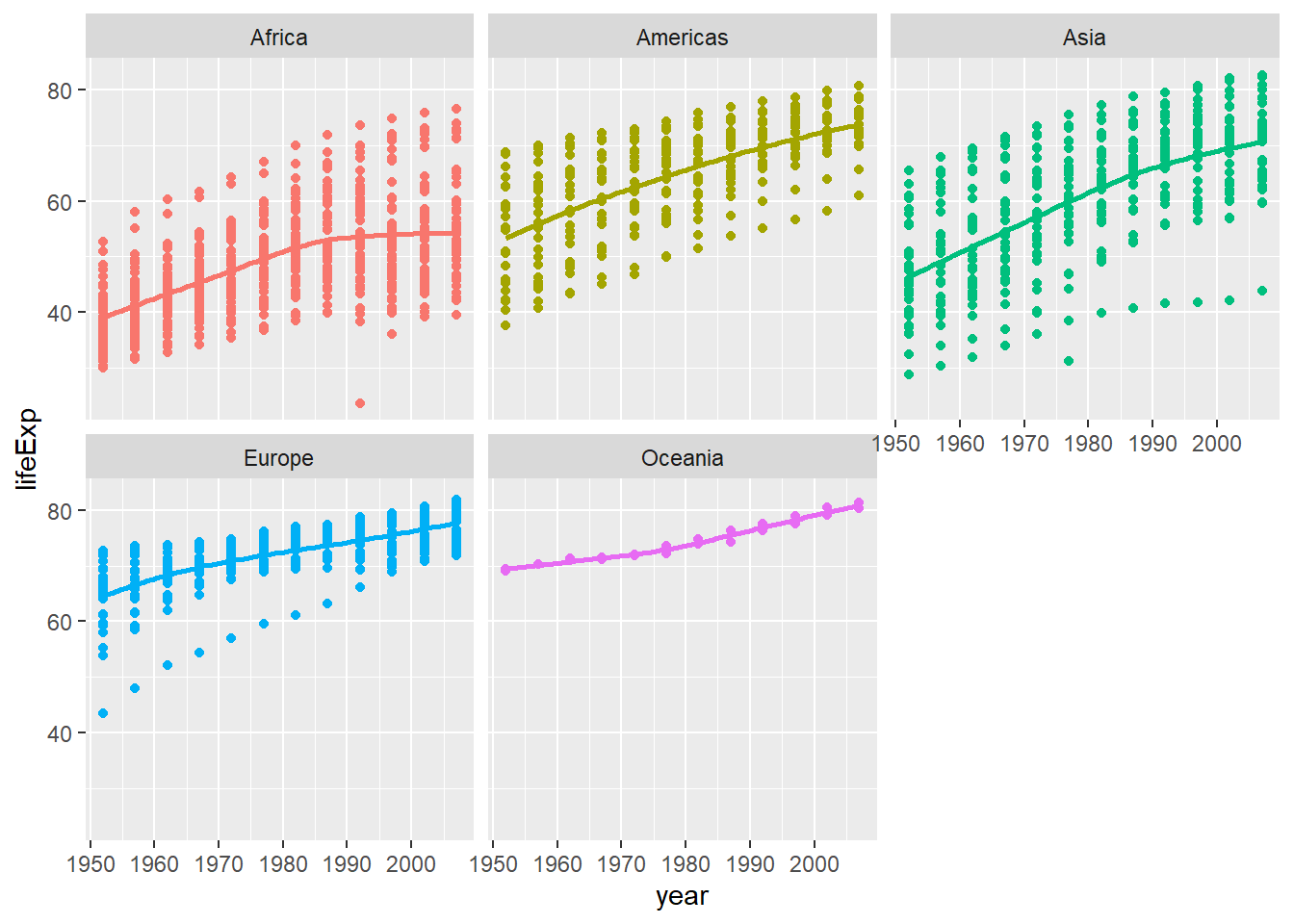
Given these trends, what can you say about life expectancy since 1952? Again, don’t just say what’s happening in the graph. Tell some of story and speculate about the differences in the patterns.
Overall, the life expectancy since 1952 was growing in all five continents. In 1952, Europe had the higest life expectancy, which was more than 60 on average.On the other hand, Africa had the lowest life expectancy, which was around 40 on average. Currently, Europe and Oceania the highest life expectancy, which are up to 80. Near them, Asia and America increased to about 70.
Task 2: Brexit vote analysis
We will have a look at the results of the 2016 Brexit vote in the UK. First we read the data using read_csv() and have a quick glimpse at the data
brexit_results <- read_csv(here::here("data","brexit_results.csv"))
glimpse(brexit_results)
## Rows: 632
## Columns: 11
## $ Seat <chr> "Aldershot", "Aldridge-Brownhills", "Altrincham and Sale W~
## $ con_2015 <dbl> 50.592, 52.050, 52.994, 43.979, 60.788, 22.418, 52.454, 22~
## $ lab_2015 <dbl> 18.333, 22.369, 26.686, 34.781, 11.197, 41.022, 18.441, 49~
## $ ld_2015 <dbl> 8.824, 3.367, 8.383, 2.975, 7.192, 14.828, 5.984, 2.423, 1~
## $ ukip_2015 <dbl> 17.867, 19.624, 8.011, 15.887, 14.438, 21.409, 18.821, 21.~
## $ leave_share <dbl> 57.89777, 67.79635, 38.58780, 65.29912, 49.70111, 70.47289~
## $ born_in_uk <dbl> 83.10464, 96.12207, 90.48566, 97.30437, 93.33793, 96.96214~
## $ male <dbl> 49.89896, 48.92951, 48.90621, 49.21657, 48.00189, 49.17185~
## $ unemployed <dbl> 3.637000, 4.553607, 3.039963, 4.261173, 2.468100, 4.742731~
## $ degree <dbl> 13.870661, 9.974114, 28.600135, 9.336294, 18.775591, 6.085~
## $ age_18to24 <dbl> 9.406093, 7.325850, 6.437453, 7.747801, 5.734730, 8.209863~The data comes from Elliott Morris, who cleaned it and made it available through his DataCamp class on analysing election and polling data in R.
Our main outcome variable (or y) is leave_share, which is the percent of votes cast in favour of Brexit, or leaving the EU. Each row is a UK parliament constituency.
To get a sense of the spread, or distribution, of the data, we can plot a histogram, a density plot, and the empirical cumulative distribution function of the leave % in all constituencies.
# histogram
ggplot(brexit_results, aes(x = leave_share)) +
  geom_histogram(binwidth = 2.5)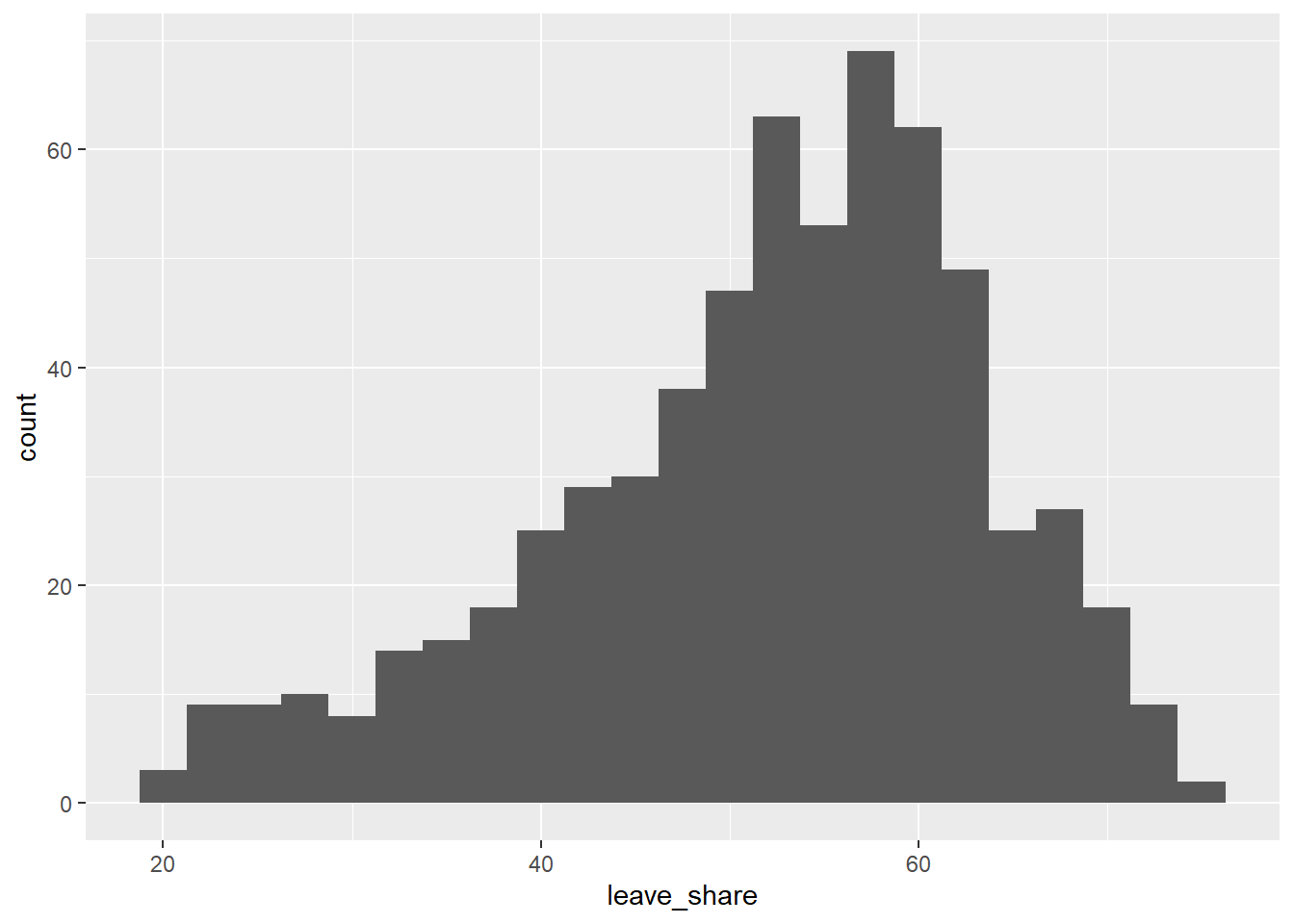
# density plot-- think smoothed histogram
ggplot(brexit_results, aes(x = leave_share)) +
  geom_density()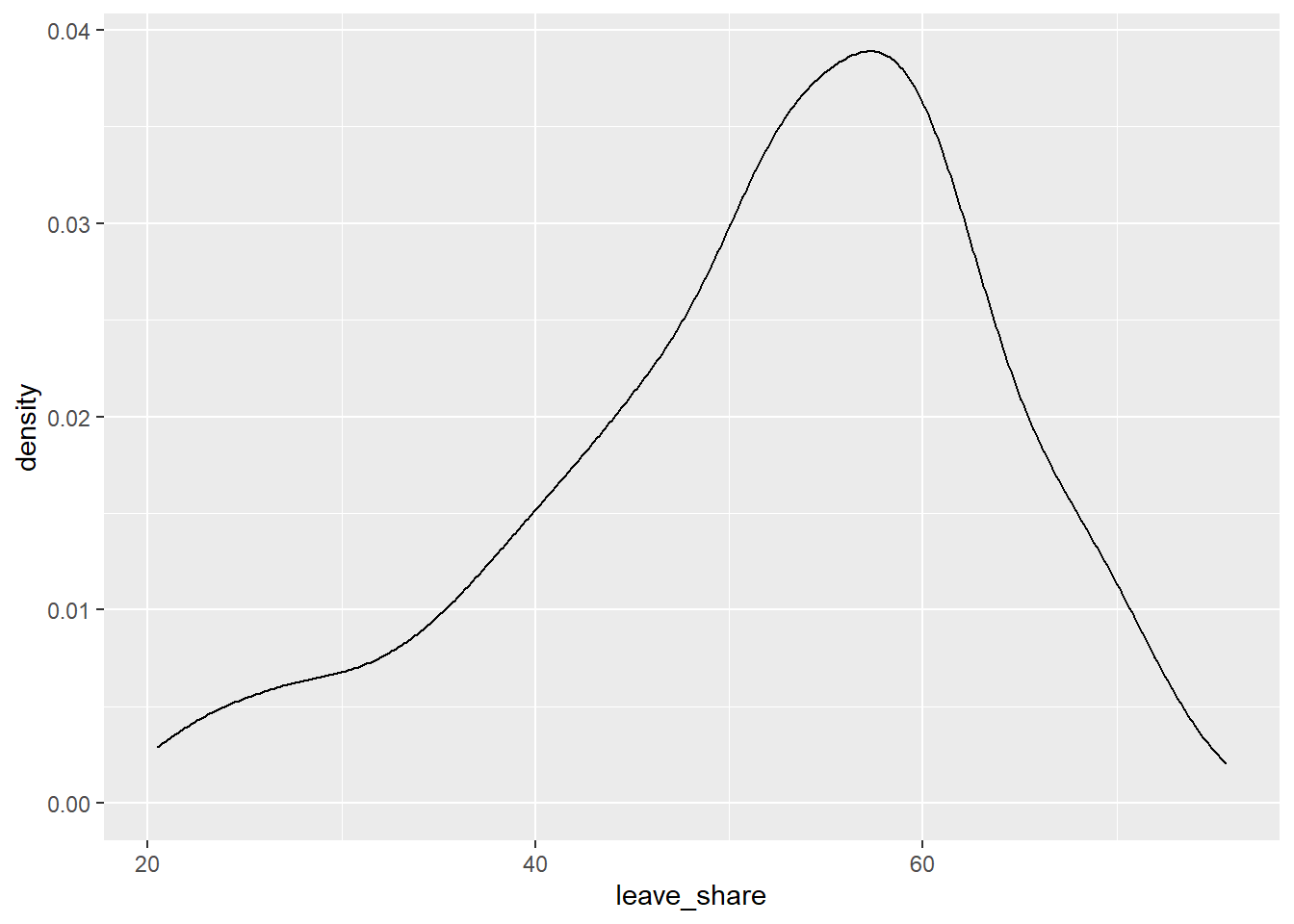
# The empirical cumulative distribution function (ECDF)
ggplot(brexit_results, aes(x = leave_share)) +
  stat_ecdf(geom = "step", pad = FALSE) +
  scale_y_continuous(labels = scales::percent)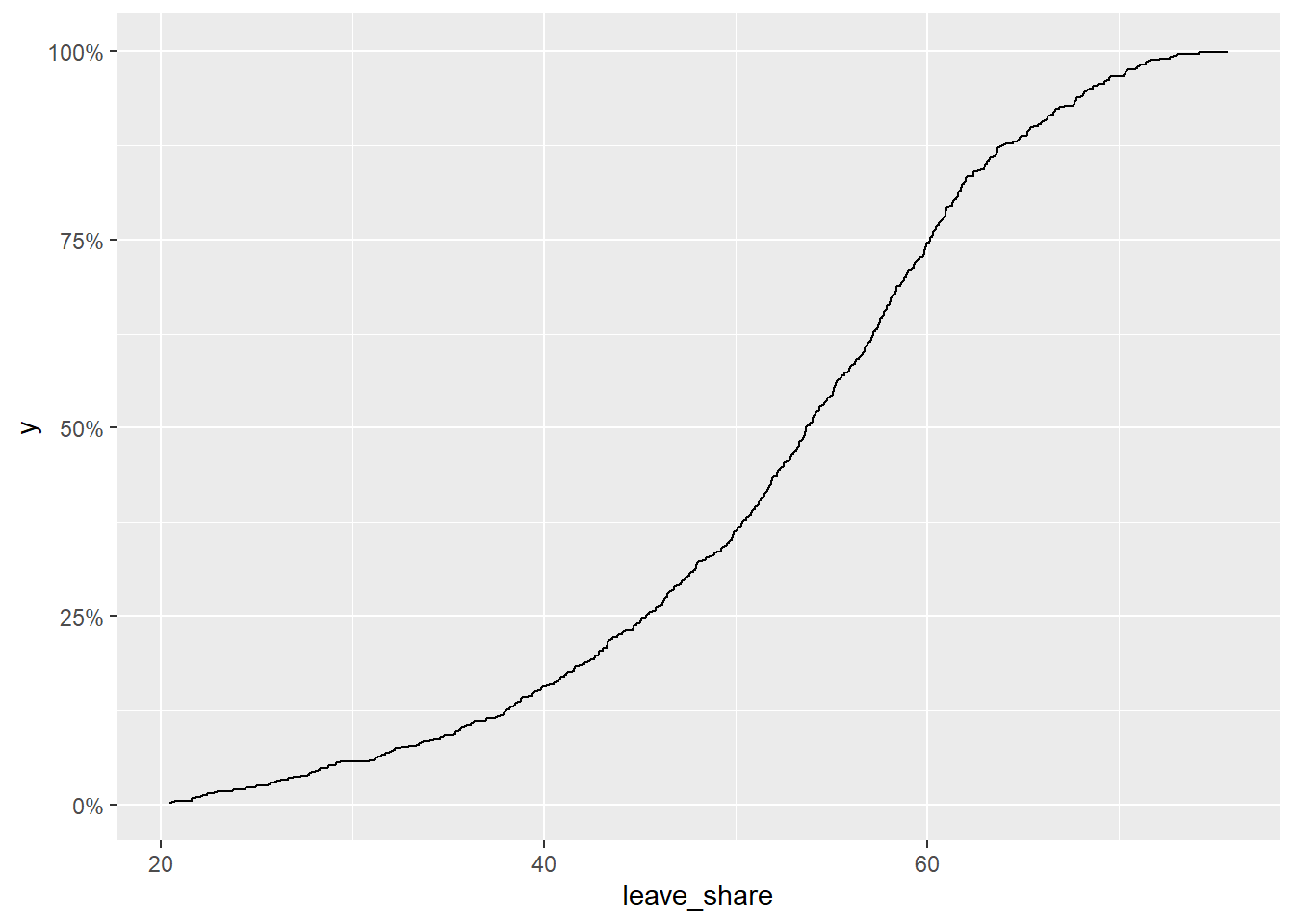
One common explanation for the Brexit outcome was fear of immigration and opposition to the EU’s more open border policy. We can check the relationship (or correlation) between the proportion of native born residents (born_in_uk) in a constituency and its leave_share. To do this, let us get the correlation between the two variables
brexit_results %>%
  select(leave_share, born_in_uk) %>%
  cor()
## leave_share born_in_uk
## leave_share 1.0000000 0.4934295
## born_in_uk 0.4934295 1.0000000The correlation is almost 0.5, which shows that the two variables are positively correlated.
We can also create a scatterplot between these two variables using geom_point. We also add the best fit line, using geom_smooth(method = "lm").
plot2<-ggplot(brexit_results, aes(x = born_in_uk, y = leave_share)) +
  geom_point(alpha=0.3) +

  # add a smoothing line, and use method="lm" to get the best straight-line
  geom_smooth(method = "lm") +

  # use a white background and frame the plot with a black box
  theme_bw() +
  NULL
plot2
## `geom_smooth()` using formula 'y ~ x'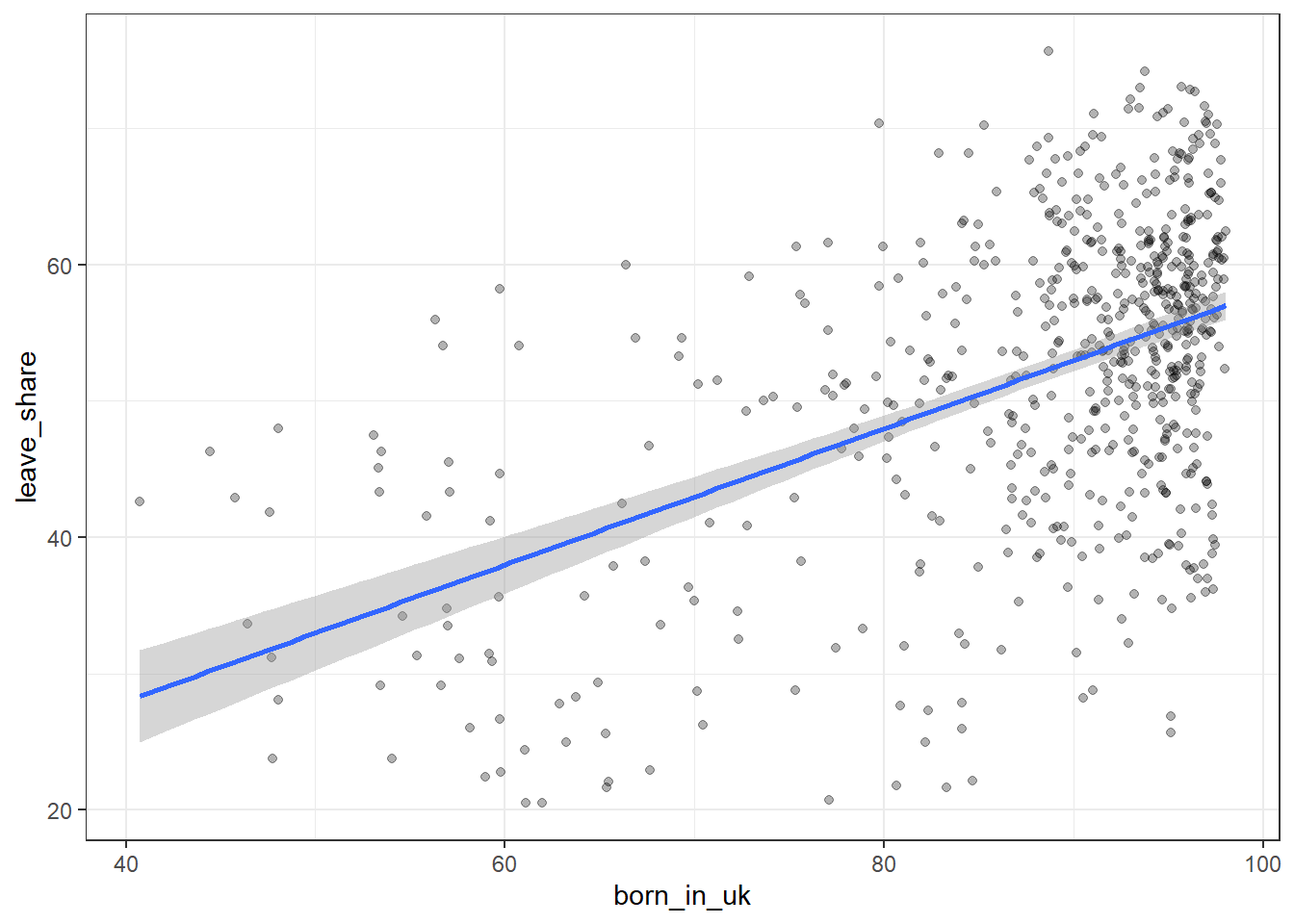
You have the code for the plots, I would like you to revisit all of them and use the labs() function to add an informative title, subtitle, and axes titles to all plots.
plot2<- plot2 +
   labs(title = "Correlation between Leave Share and UK Born ",
       x = "Born in UK",
       y = "Leave Share ")

plot2
## `geom_smooth()` using formula 'y ~ x'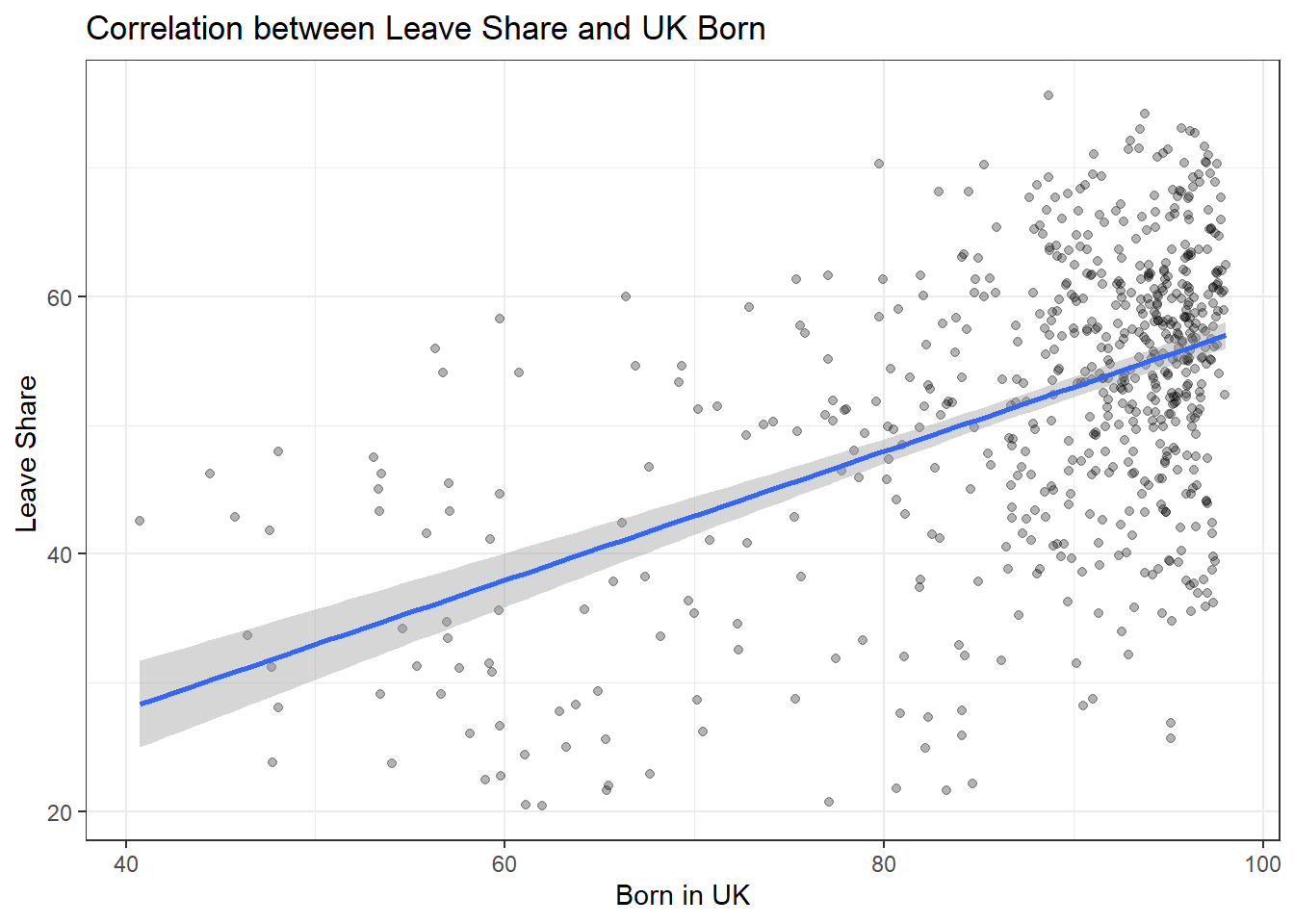
What can you say about the relationship shown above? Again, don’t just say what’s happening in the graph. Tell some sort of story and speculate about the differences in the patterns.
The rate of people born in UK had positive relationship with the leave share. When a seat had more people born in UK, it inclined to mean that the leave share would be higher. Most points were clustered at the right half of the picture. It meant that most seats have people born in UK up to 80 percent and the leave share was on average clustered at more than 50 percent, which directly leave to the decision of Brexit.
Task 3: Animal rescue incidents attended by the London Fire Brigade
The London Fire Brigade attends a range of non-fire incidents (which we call ‘special services’). These ‘special services’ include assistance to animals that may be trapped or in distress. The data is provided from January 2009 and is updated monthly. A range of information is supplied for each incident including some location information (postcode, borough, ward), as well as the data/time of the incidents. We do not routinely record data about animal deaths or injuries.
Please note that any cost included is a notional cost calculated based on the length of time rounded up to the nearest hour spent by Pump, Aerial and FRU appliances at the incident and charged at the current Brigade hourly rate.
url <- "https://data.london.gov.uk/download/animal-rescue-incidents-attended-by-lfb/8a7d91c2-9aec-4bde-937a-3998f4717cd8/Animal%20Rescue%20incidents%20attended%20by%20LFB%20from%20Jan%202009.csv"

animal_rescue <- read_csv(url,
                          locale = locale(encoding = "CP1252")) %>%
  janitor::clean_names()


glimpse(animal_rescue)
## Rows: 7,873
## Columns: 31
## $ incident_number <chr> "139091", "275091", "2075091", "2872091"~
## $ date_time_of_call <chr> "01/01/2009 03:01", "01/01/2009 08:51", ~
## $ cal_year <dbl> 2009, 2009, 2009, 2009, 2009, 2009, 2009~
## $ fin_year <chr> "2008/09", "2008/09", "2008/09", "2008/0~
## $ type_of_incident <chr> "Special Service", "Special Service", "S~
## $ pump_count <chr> "1", "1", "1", "1", "1", "1", "1", "1", ~
## $ pump_hours_total <chr> "2", "1", "1", "1", "1", "1", "1", "1", ~
## $ hourly_notional_cost <dbl> 255, 255, 255, 255, 255, 255, 255, 255, ~
## $ incident_notional_cost <chr> "510", "255", "255", "255", "255", "255"~
## $ final_description <chr> "Redacted", "Redacted", "Redacted", "Red~
## $ animal_group_parent <chr> "Dog", "Fox", "Dog", "Horse", "Rabbit", ~
## $ originof_call <chr> "Person (land line)", "Person (land line~
## $ property_type <chr> "House - single occupancy", "Railings", ~
## $ property_category <chr> "Dwelling", "Outdoor Structure", "Outdoo~
## $ special_service_type_category <chr> "Other animal assistance", "Other animal~
## $ special_service_type <chr> "Animal assistance involving livestock -~
## $ ward_code <chr> "E05011467", "E05000169", "E05000558", "~
## $ ward <chr> "Crystal Palace & Upper Norwood", "Woods~
## $ borough_code <chr> "E09000008", "E09000008", "E09000029", "~
## $ borough <chr> "Croydon", "Croydon", "Sutton", "Hilling~
## $ stn_ground_name <chr> "Norbury", "Woodside", "Wallington", "Ru~
## $ uprn <chr> "NULL", "NULL", "NULL", "100021491149.00~
## $ street <chr> "Waddington Way", "Grasmere Road", "Mill~
## $ usrn <chr> "20500146.00", "NULL", "NULL", "21401484~
## $ postcode_district <chr> "SE19", "SE25", "SM5", "UB9", "RM3", "RM~
## $ easting_m <chr> "NULL", "534785", "528041", "504689", "N~
## $ northing_m <chr> "NULL", "167546", "164923", "190685", "N~
## $ easting_rounded <dbl> 532350, 534750, 528050, 504650, 554650, ~
## $ northing_rounded <dbl> 170050, 167550, 164950, 190650, 192350, ~
## $ latitude <chr> "NULL", "51.39095371", "51.36894086", "5~
## $ longitude <chr> "NULL", "-0.064166887", "-0.161985191", ~One of the more useful things one can do with any data set is quick counts, namely to see how many observations fall within one category. For instance, if we wanted to count the number of incidents by year, we would either use group_by()... summarise() or, simply count()
animal_rescue %>%
  dplyr::group_by(cal_year) %>%
  summarise(count=n())
## # A tibble: 13 x 2
## cal_year count
## <dbl> <int>
## 1 2009 568
## 2 2010 611
## 3 2011 620
## 4 2012 603
## 5 2013 585
## 6 2014 583
## 7 2015 540
## 8 2016 604
## 9 2017 539
## 10 2018 610
## 11 2019 604
## 12 2020 758
## 13 2021 648animal_rescue %>%
count(cal_year, name="count")## # A tibble: 13 x 2
## cal_year count
## <dbl> <int>
## 1 2009 568
## 2 2010 611
## 3 2011 620
## 4 2012 603
## 5 2013 585
## 6 2014 583
## 7 2015 540
## 8 2016 604
## 9 2017 539
## 10 2018 610
## 11 2019 604
## 12 2020 758
## 13 2021 648Let us try to see how many incidents we have by animal group. Again, we can do this either using group_by() and summarise(), or by using count()
animal_rescue %>%
  group_by(animal_group_parent) %>%

  #group_by and summarise will produce a new column with the count in each animal group
  summarise(count = n()) %>%

  # mutate adds a new column; here we calculate the percentage
  mutate(percent = round(100*count/sum(count),2)) %>%

  # arrange() sorts the data by percent. Since the default sorting is min to max and we would like to see it sorted
  # in descending order (max to min), we use arrange(desc())
  arrange(desc(percent))
## # A tibble: 28 x 3
## animal_group_parent count percent
## <chr> <int> <dbl>
## 1 Cat 3783 48.0
## 2 Bird 1631 20.7
## 3 Dog 1230 15.6
## 4 Fox 373 4.74
## 5 Unknown - Domestic Animal Or Pet 201 2.55
## 6 Horse 195 2.48
## 7 Deer 136 1.73
## 8 Unknown - Wild Animal 94 1.19
## 9 Squirrel 68 0.86
## 10 Unknown - Heavy Livestock Animal 50 0.64
## # ... with 18 more rowsanimal_rescue %>%
#count does the same thing as group_by and summarise
# name = "count" will call the column with the counts "count" ( exciting, I know)
# and 'sort=TRUE' will sort them from max to min
count(animal_group_parent, name="count", sort=TRUE) %>%
mutate(percent = round(100*count/sum(count),2))## # A tibble: 28 x 3
## animal_group_parent count percent
## <chr> <int> <dbl>
## 1 Cat 3783 48.0
## 2 Bird 1631 20.7
## 3 Dog 1230 15.6
## 4 Fox 373 4.74
## 5 Unknown - Domestic Animal Or Pet 201 2.55
## 6 Horse 195 2.48
## 7 Deer 136 1.73
## 8 Unknown - Wild Animal 94 1.19
## 9 Squirrel 68 0.86
## 10 Unknown - Heavy Livestock Animal 50 0.64
## # ... with 18 more rowsDo you see anything strange in these tables?
Finally, let us have a loot at the notional cost for rescuing each of these animals. As the LFB says,
Please note that any cost included is a notional cost calculated based on the length of time rounded up to the nearest hour spent by Pump, Aerial and FRU appliances at the incident and charged at the current Brigade hourly rate.
There is two things we will do:
- Calculate the mean and median
incident_notional_costfor eachanimal_group_parent - Plot a boxplot to get a feel for the distribution of
incident_notional_costbyanimal_group_parent.
Before we go on, however, we need to fix incident_notional_cost as it is stored as a chr, or character, rather than a number.
# what type is variable incident_notional_cost from dataframe `animal_rescue`
typeof(animal_rescue$incident_notional_cost)
## [1] "character"# readr::parse_number() will convert any numerical values stored as characters into numbers
animal_rescue <- animal_rescue %>%
# we use mutate() to use the parse_number() function and overwrite the same variable
mutate(incident_notional_cost = parse_number(incident_notional_cost))
# incident_notional_cost from dataframe `animal_rescue` is now 'double' or numeric
typeof(animal_rescue$incident_notional_cost)## [1] "double"Now that incident_notional_cost is numeric, let us quickly calculate summary statistics for each animal group.
stats_on_incident_cost<-animal_rescue %>%

  # group by animal_group_parent
  group_by(animal_group_parent) %>%

  # filter resulting data, so each group has at least 6 observations
  filter(n()>6) %>%

  # summarise() will collapse all values into 3 values: the mean, median, and count
  # we use na.rm=TRUE to make sure we remove any NAs, or cases where we do not have the incident cos
  summarise(mean_incident_cost = mean (incident_notional_cost, na.rm=TRUE),
            median_incident_cost = median (incident_notional_cost, na.rm=TRUE),
            sd_incident_cost = sd (incident_notional_cost, na.rm=TRUE),
            min_incident_cost = min (incident_notional_cost, na.rm=TRUE),
            max_incident_cost = max (incident_notional_cost, na.rm=TRUE),
            count = n()) %>%

  # sort the resulting data in descending order. You choose whether to sort by count or mean cost.
  arrange(desc(mean_incident_cost))
Compare the mean and the median for each animal group. What do you think this is telling us? Anything else that stands out? Any outliers?
The mean of incident cost for nearly all animals are greater than the median for each animal group. it tells us that some outliers would be counted to increase the mean for those animal groups. For example, the horse’s mean notinal cost is 739, which was significantly geater than its median – 596.
Finally, let us plot a few plots that show the distribution of incident_cost for each animal group.
# base_plot
base_plot <- animal_rescue %>%
  group_by(animal_group_parent) %>%
  filter(n()>6) %>%
  ggplot(aes(x=incident_notional_cost))+
  facet_wrap(~animal_group_parent, scales = "free")+
  theme_bw()

base_plot + geom_histogram()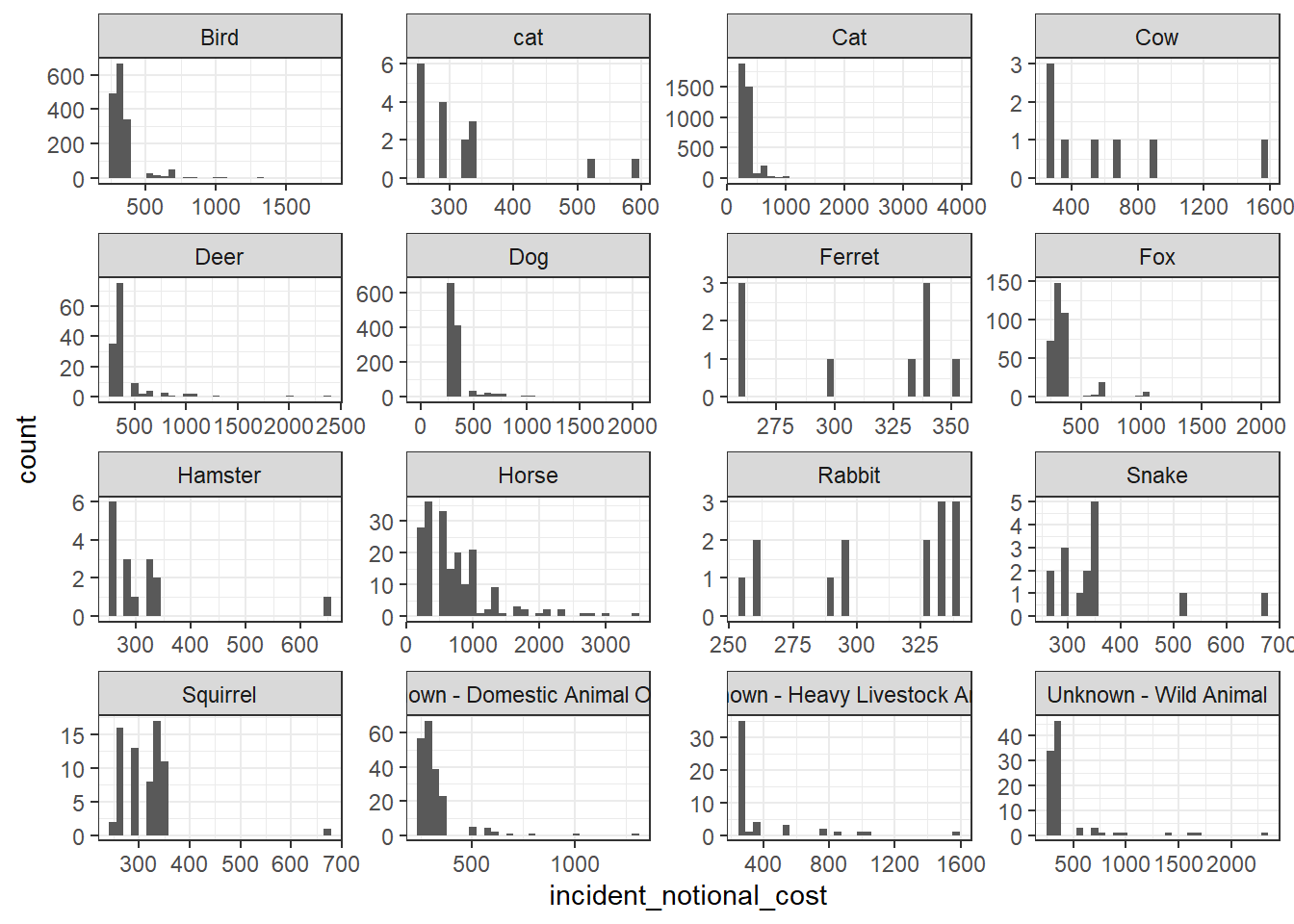
base_plot + geom_density()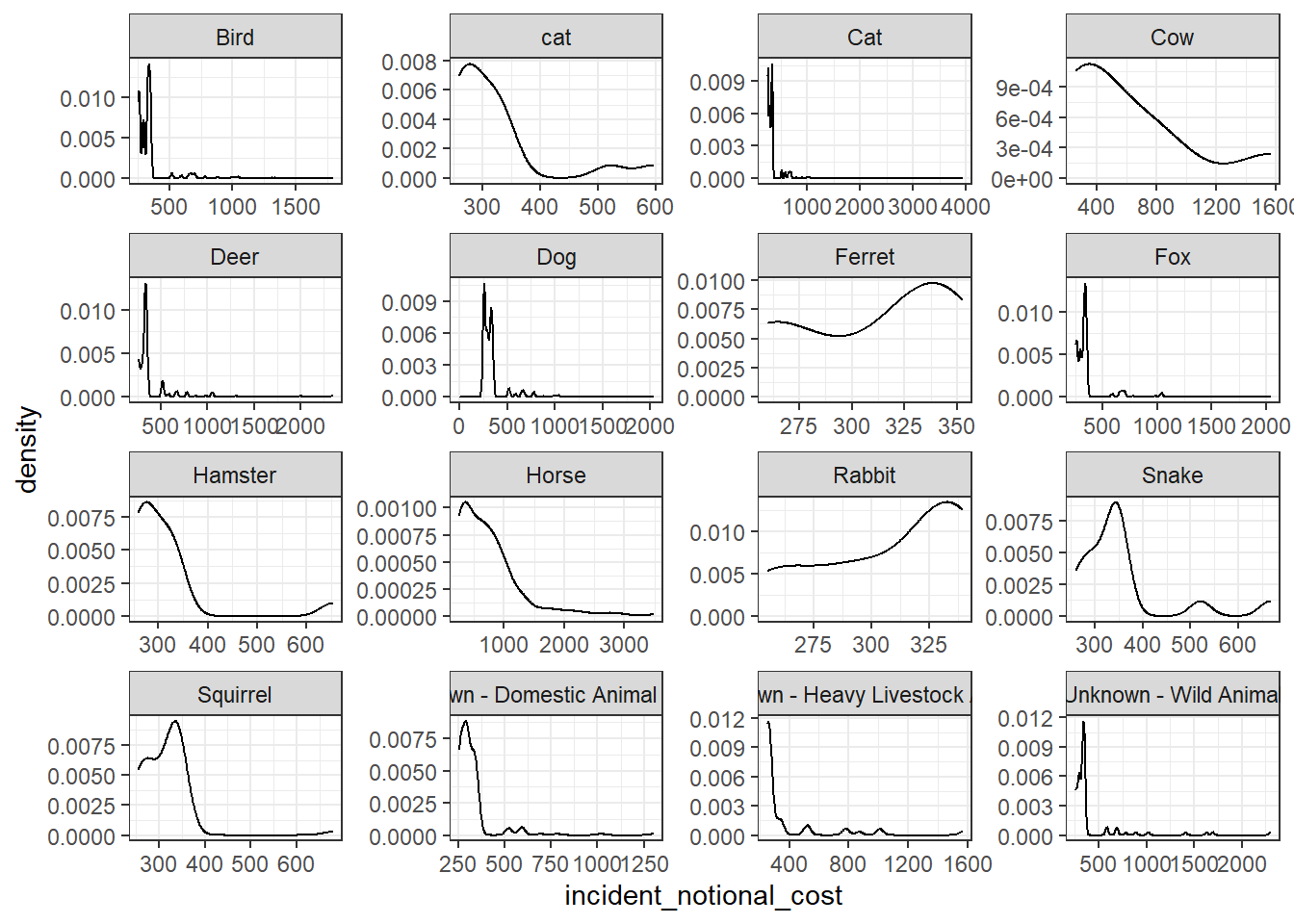
base_plot + geom_boxplot()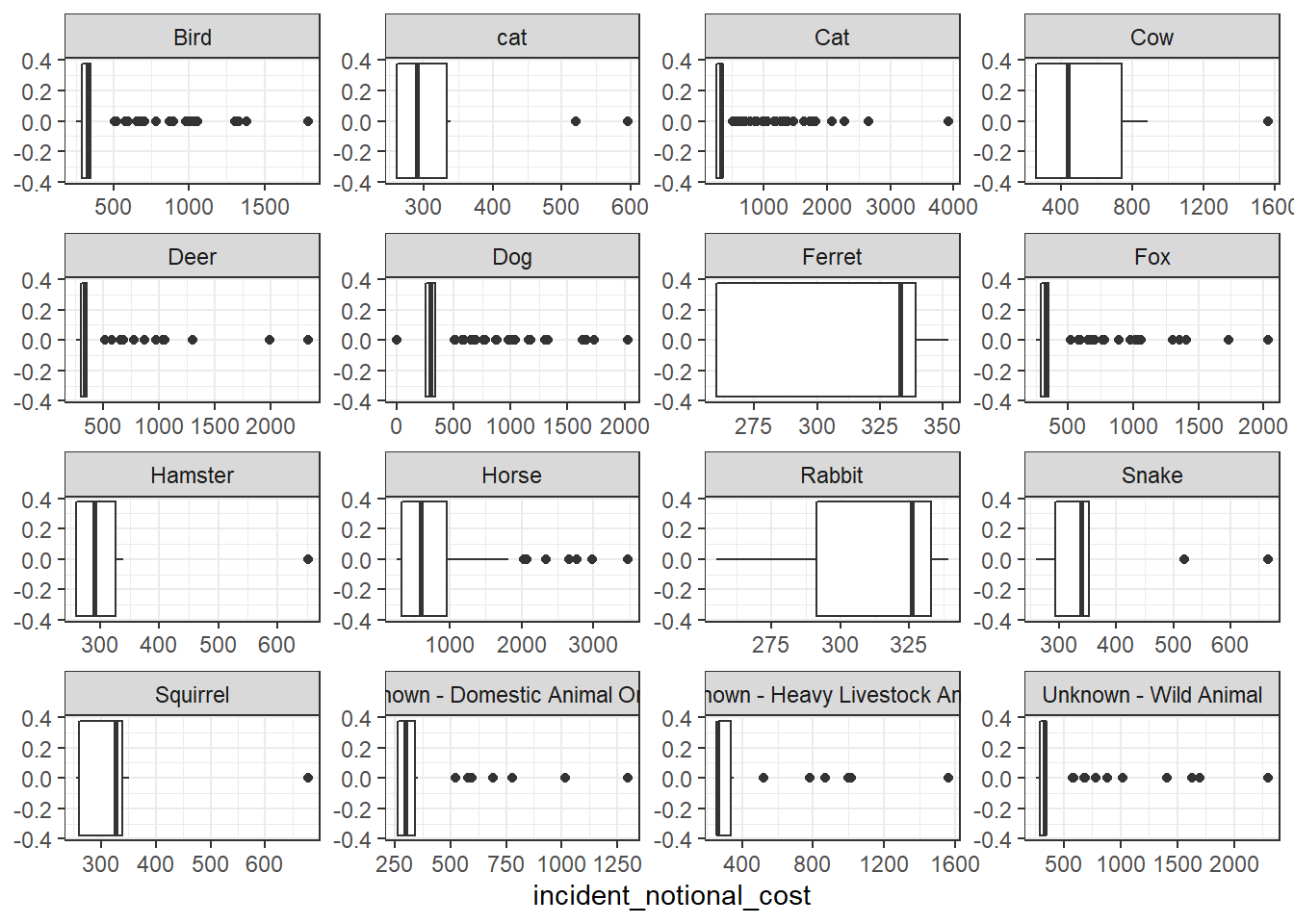
base_plot + stat_ecdf(geom = "step", pad = FALSE) +
  scale_y_continuous(labels = scales::percent)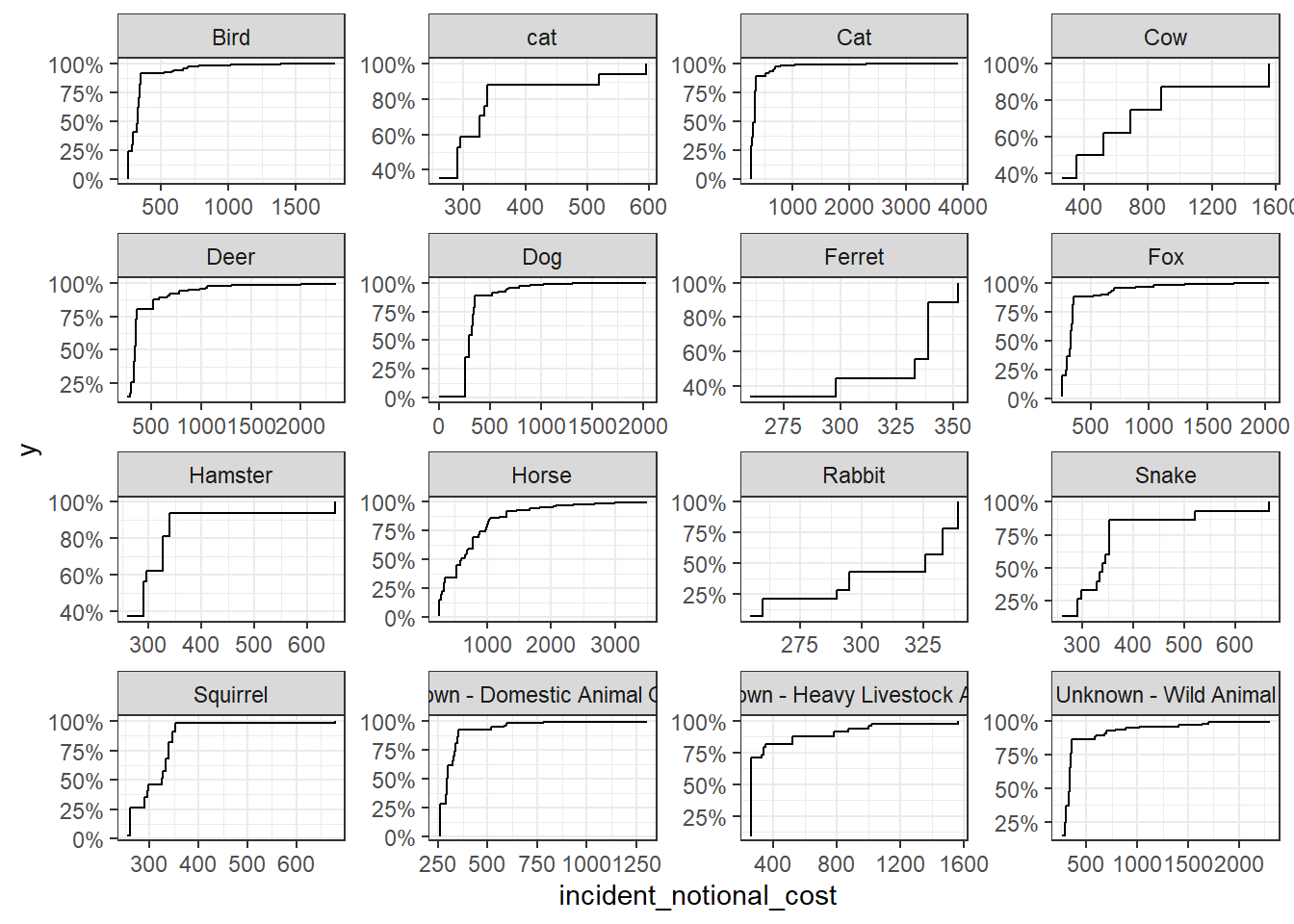
Which of these four graphs do you think best communicates the variability of the incident_notional_cost values? Also, can you please tell some sort of story (which animals are more expensive to rescue than others, the spread of values) and speculate about the differences in the patterns.
The histogram communicate the variability of the incident notional cost the best. It counted the number of each animals rescued and the notional cost accordingly. We could conclude that Horse was the most expensive animals t rescue compared to others, which costed more than 500 for many of its rescue. From the perspective of rescue pattern, we could find that some animals have costs variably (such as rabbit) while some animals have costs concentrated to a small range(such as squirrel).